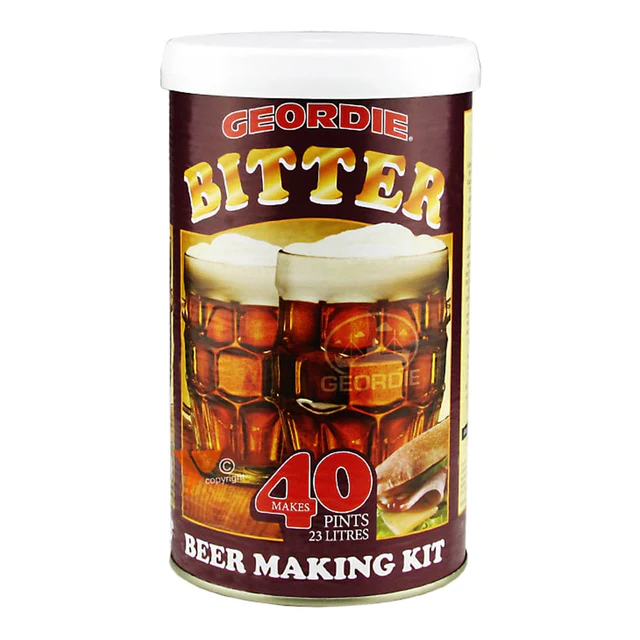


And brew day is upon us again!
So what do we have this time? We have a Tropic Thunder NEIPA (New England IPA for the uninitiated) from Dark Farm Homebrewing. Again I will point out that I am in no way sponsored or affiliated with this homebrew supplier and so the following will be my honest and free opinions of the kit.
So, what is in the kit, I hear you cry! Well with this being a NEIPA, there is a lot going on. In terms of grains, we have Pale Malt, Wheat Malt, Oat Malt, Carapils and Biscuit Malt. Hops wise, there are Citra, Azacca, Elani, Blanc and Harlequin. Finally there is Mango Madness IPA yeast from WHC Labs. This all turned up well packaged in a reasonably small box.
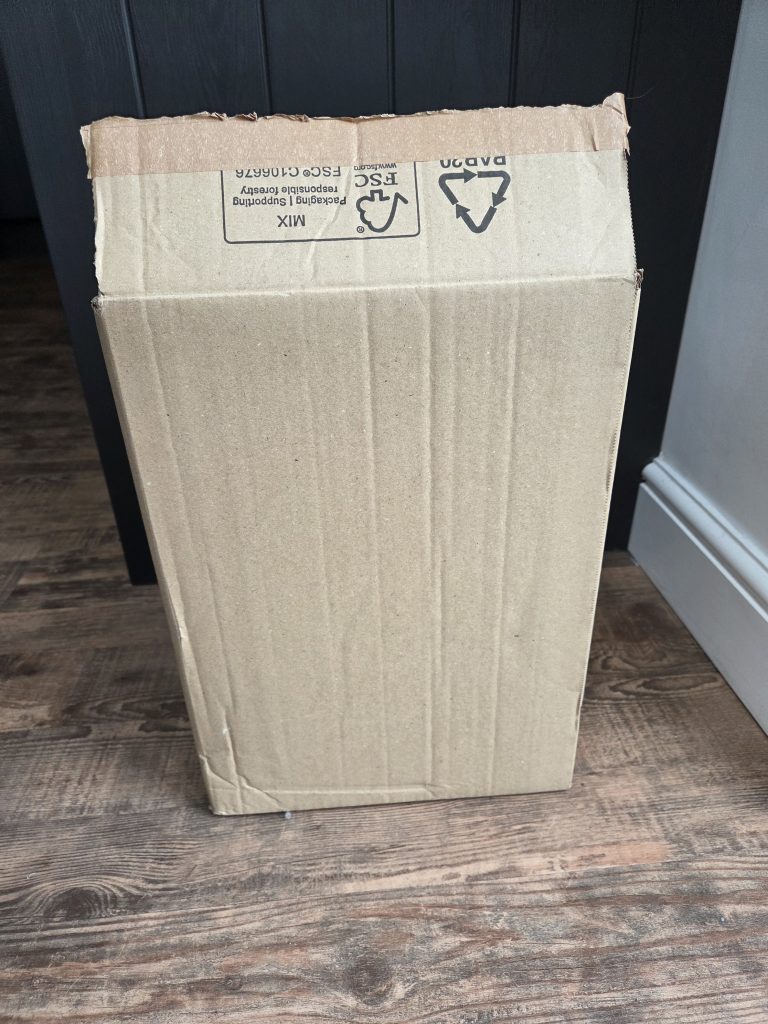
As you can see there is a lot going on and that is before you get to the brewing instructions.
The hops are well packaged in sealed, heavy-duty, re-sealable plastic bags. Some of them had numbers hand written on the label which at first caused me some confusion. It was only after I had read the brewing instructions that I realised these were the hop addition times for the boil, which is a nice touch.
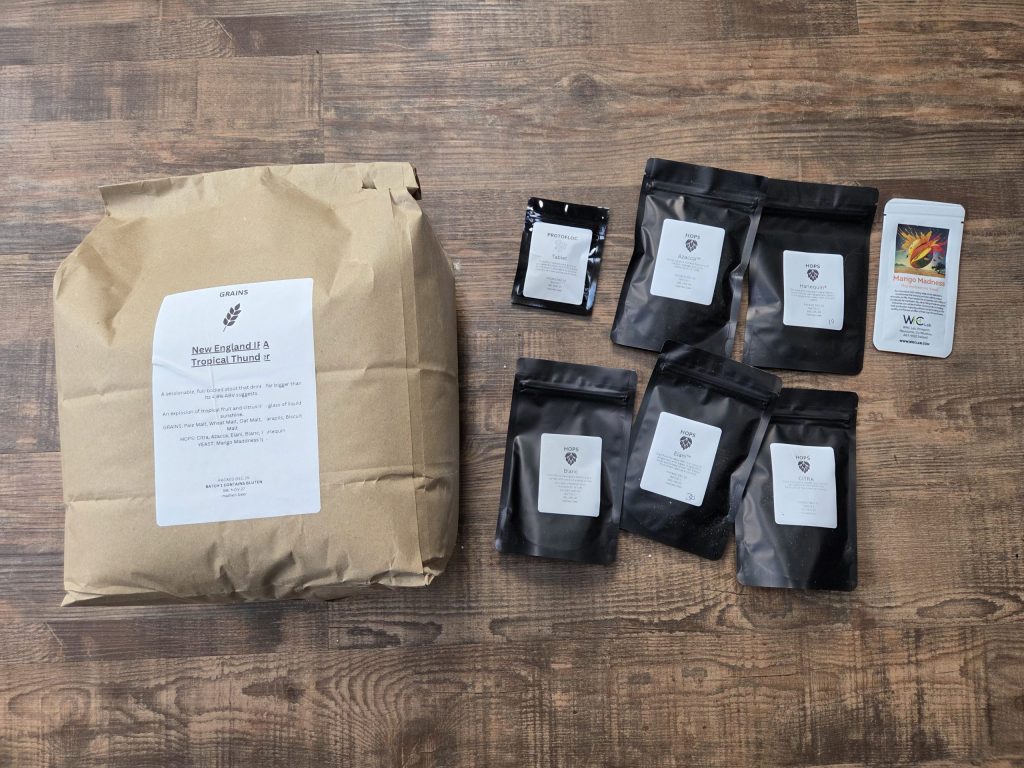
The grain mix is put inside what I can only describe as a brown paper bag, stapled at the top to stop it from opening. Whilst this works, it does mean the grain has a short shelf life as it is essentially open to air. I also found that the staple in the top of the bag started ripping through the paper as i was handling it, resulting in some spillage. Granted I can’t blame the supplier for my clumsiness, but I do prefer the more sturdy nylon bags used in other brewing kits.
I’ve also found that when the grain comes in plastic bags, they have a longer shelf life. Whilst some people might question why I’m not brewing straight away, sometimes life throws things at you that means you have to put off brew day for a week or two.
All that being said, the grain mix was fresh (and tasty) so no complaints on that front.
The recipe card for the beer can be found within a small magazine enclosed within the box. I wasn’t expecting it to be in there so when it appeared about halfway through I was quite surprised. Even more surprising was that it contained the recipes for all beer available on their website.
Granted, this sounds like I’m complaining but I’m not. The magazine is a good read and well presented. It contains a number of interviews with independent breweries, a few articles on different yeasts and hops, and a list of upcoming beer festivals. The brewing instructions are also nice and clear. It even gave mash and sparge water volumes.
Now here comes a bit of a warning. This beer is probably not a good choice for someone starting out. I like to think that I have a good few brews under my belt but this was a bit of a challenge. The brewing process calls for multiple temperature rests and this was a first for me. As I’m not used to doing this, I found that I would overshoot the temperatures. In my naivety, I would set my kettle to the temperature required and let it heat up. But due to the residual heat off the element, the temperature of the wort would continue to rise after the cut-off.
I would like to try another beer brewed in this way. When I do, I will set the temperature a good 5 degrees lower than required and make sure the wort is being circulated appropriately. I suspect that this may then top out at the correct temperature, and then I can simply hold it there.
Something that is quite good is that the recipe gives you pre and post boil gravity figures. Unfortunately I only took a reading post boil and I undershot the required figure by quite a bit. Again, in hindsight I would have taken a reading pre-boil and corrected as necessary before continuing. You live, you learn and I’ll take that experience into my next brew. Having looked up what I’d need to do to hit the correct figure, I would have needed to boil off nearly an additional 5 litres (over a gallon). I’m not entirely sure what the cause of this was. Poor efficiency? Wort needed a stir? Grains needed finer crush? I’m definitely going to have a look into this.
For the boil, there were a number of hop additions at various times, and as mentioned earlier, some were marked on the packets of hops. Some of the larger packets had to be weighed out separately as part of the hops were to be used for the boil, and part for dry hopping during fermentation.
When it come to cooling the wort, I had a bit of a minor mishap. One of the tubes connected to my cooling coil popped off, basically leaving a running hosepipe on the kitchen floor. Luckily, I managed to turn off the garden tap quickly and mop up the water.
Once cooled to around 20°C (68°F), I took my opening gravity reading and it hit 1.050. It should have been 1.065. Once the yeast was pitched, I was to dry hop for three days. I had some muslin bags knocking around that I could put the hops in. This makes it easier to fish out the hops after a few days. This is where hop tea bags would be ideal but I have to appreciate that not all brew suppliers can provide hops in this format. Another new one for me was that the recipe said to ferment at 30-35°C (86-95°F). Whilst I do have a fish tank heater that I’ve used in the past, it requires a bit of setting up and I hadn’t read the instructions in advance (yes, schoolboy error on my part). So I’ll keep it in my usual spot for fermenting and hope for the best.
Final gravity hit 1.012. Slightly lower that the 1.014 suggested. This should give me an ABV of 4.99%. Somewhat lower than the 6.5% that was targeted but it did smell divine so I’m hoping it will turn out well.
Overall, what are my thoughts about this kit? As mentioned before, I would recommend having a few brews under your belt as the different temperature rests require a bit of finesse and experience. It also makes your brew day a bit longer so just be conscious of that if pushed for time. I also wasn’t keen on the packaging for the malts.
I did like the recipe coming in the magazine but found it odd that the website offers the recipe online for £3, and yet all recipes were printed in this magazine. Regardless, the magazine was well presented and interesting.
The hops were well sealed and all ingredients seemed fresh.
Something else to be aware of is that this kit is for brewing 20 litres of beer. Previously, any all grain kit I had brewed was either 23 or 25 litres. 20 litre kits are not uncommon (they tend to fit nicely in a 19 litre corny keg), it’s just something to bear in mind.
I feel like I’m being a bit harsh on this kit. I am quite happy with it. The wort smelled lovely before fermenting and I’m really looking forward to trying it.
For now, it’s merrily doing its “bloble” and I’ll post a follow-up once bottled. In the meantime, feel free to get in touch with any questions or suggestions.